
Understanding how expensive mahogany wood is often becomes the first hurdle for designers and homeowners looking for that timeless, reddish-brown glow. We recognize that navigating timber pricing feels like a maze of board feet and international regulations.
Mahogany stands as a symbol of prestige, but its cost isn’t just about the label: it is about history, biology, and the sheer effort of bringing a piece of nature into a home.
Let us look beyond the price tag to see what really makes this wood special.
The Current Financial Landscape of Mahogany Timber
Navigating the global timber market requires a clear understanding of current price benchmarks and how they fluctuate based on quality and availability.
- Raw Lumber Pricing: On the international stage, genuine mahogany (Swietenia macrophylla) typically trades between $6.00 and $15.00 per board foot. For high-grade, wide planks, prices can easily climb higher.
- Species Differentiation: Not all mahogany is created equal. While African Mahogany (Khaya) offers a more budget-friendly alternative at roughly $5.00 to $8.00 per board foot, Honduran or Cuban varieties remain the gold standard of luxury.
- Market Comparison: It is helpful to view these numbers against other hardwoods. While mahogany is significantly costlier than Oak or Maple, it remains more accessible than premium Teak, which often exceeds $25.00 per board foot.
Unlocking the Mystery: Why is Mahogany Expensive?
We often encounter questions about the premium nature of this wood, and the answers lie in a mix of natural limitations and necessary global protections.
Biological Scarcity and Slow Growth
Pohon mahogany does not reach maturity in a few years. It takes decades, often between 25 to 40 years, for a tree to reach a diameter suitable for high-quality furniture production.
In the wild, these trees are often solitary, with perhaps only one mature tree per hectare of forest. This natural distribution makes harvesting a labor-intensive process that respects the forest’s delicate balance rather than clearing it out entirely.
The Impact of CITES and Conservation
Conservation is a major factor in pricing. Most genuine mahogany species are listed under CITES Appendix II. This international agreement ensures that the timber is harvested sustainably to prevent extinction.
While these regulations are vital for our planet, they add layers of bureaucratic costs and export quotas that naturally increase the final price. We believe these protections are essential because they guarantee that the wood you buy today will still exist in the forests for future generations.
Compliance and Legal Certification Costs
Every shipment of mahogany must be traceable. In Indonesia, the SVLK (Sistem Verifikasi Legalitas Kayu) provides a rigorous audit trail from the forest to the final product. Maintaining these certifications requires continuous investment in audits and transparent supply chain management.
These costs ensure that the wood is not only beautiful but also 100% legal, protecting importers from the risks of illegal logging laws in their home countries.
Evaluating the Cost of Finished Mahogany Furniture
When we move from raw timber to a completed dining table or wardrobe, the question of whether mahogany furniture is expensive takes on a new meaning involving craftsmanship and logistics.
The Craftsmanship Factor
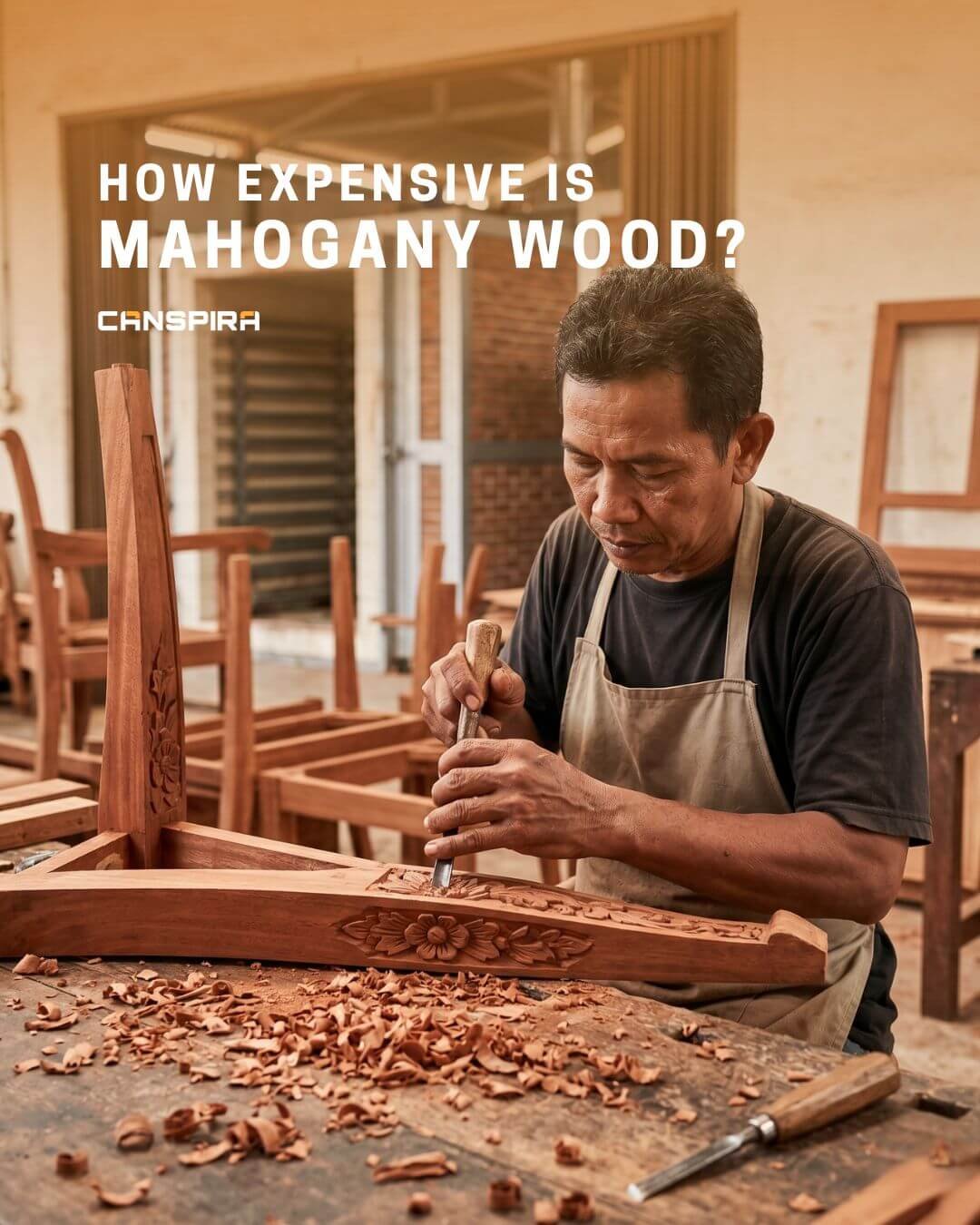
Mahogany is celebrated for its workability, making it the favorite canvas for master carvers. We see this in the intricate details of traditional English or French furniture styles. A single hand-carved chair can take weeks of manual labor.
You aren’t just paying for the material: you are paying for hundreds of hours of artisan skill passed down through generations. This human element is what transforms a piece of wood into a family heirloom.
Technical Requirements: The Kiln-Drying Process
Moisture is the enemy of fine furniture. To ensure stability, mahogany must be kiln-dried to a precise moisture content of 8% to 12%. This process is expensive, requiring large industrial kilns and significant energy consumption.
However, skipping this step leads to wood that cracks or warps once it reaches a climate-controlled home in Europe or America. We prioritize this stage because it prevents the nightmare of a beautiful piece splitting apart after only six months of use.
Material Yield and Waste Management
Producing a high-end table requires selecting the perfect grain. Often, as much as 40% of the raw timber is discarded during the production process to avoid knots, sapwood, or minor defects.
This low yield means the manufacturer must purchase more wood than what actually appears in the final piece, a reality that is reflected in the retail price.
The Global Perspective on Import Costs
Understanding how expensive mahogany wood is for an international business involves looking at the total landed cost, not just the factory price.
Shipping and FCL Dynamics
Transporting heavy hardwood furniture across oceans is a significant expense. Fluctuating container rates and the weight of solid mahogany mean that logistics can add 20% to 35% to the overall cost.
For large-scale wholesalers, optimizing Full Container Loads (FCL) is the only way to keep the individual unit price competitive for the retail market.
Quality Grading and Selection
International buyers demand consistency. “Furniture Grade” mahogany must be free of heartrot, insect damage, and large knots.
Sourcing timber that meets these global standards is a selective process that carries a higher price tag than construction-grade lumber used for less visible applications.
Viewing Mahogany as a Generational Investment
If we look at the lifespan of mahogany wood furniture, the initial price tag starts to look like a bargain over time.
Enduring Durability and Pest Resistance
Mahogany is naturally resistant to rot and termites. Unlike cheaper MDF or veneer pieces that degrade in humid environments or under heavy use, solid mahogany grows more stable as it ages.
It is not uncommon to find mahogany pieces from the 18th century still in daily use today. When you invest in quality, you only have to buy it once.
Aesthetic Aging and Patina
Many woods fade or turn gray over time, but mahogany does the opposite. It develops a deep, lustrous patina that darkens with age, increasing its visual appeal. This natural maturation means that the furniture actually looks better twenty years after you bought it, a rare trait in our modern world of disposable goods.
Resale Value in the Antique Market
Because of its reputation, mahogany holds its value exceptionally well. High-quality mahogany wood furniture often retains 70% to 85% of its value in the secondary market. If you ever choose to sell it, the return on investment is far higher than any mass-produced alternative.
Sourcing with Integrity through Canspira Indonesia
We understand that as an importer or designer, you need more than just a beautiful product: you need a reliable partner who understands the nuances of the mahogany market.
At Canspira Indonesia, we specialize in bridging the gap between Indonesian craftsmanship and global quality standards. We handle the complexities of SVLK certification and the technical precision of kiln-drying so that you don’t have to.
Whether you are looking for bespoke designs or bulk orders of Indonesian mahogany furniture, our team ensures that every piece meets the moisture content levels required for your specific climate.
We believe in transparency and excellence, ensuring that your investment in mahogany is one that brings lasting value to your business and your clients.
Note on Value: While mahogany remains a premium choice, its price is a reflection of its permanence. We invite you to explore how this remarkable timber can elevate your next collection or project through our dedicated sourcing services.Note on Value: While mahogany remains a premium choice, its price is a reflection of its permanence. We invite you to explore how this remarkable timber can elevate your next collection or project through our dedicated sourcing services.
Read also: Top Mahogany Wood Furniture Suppliers in Indonesia dan Indonesian Mahogany Furniture Manufacturer for Wholesale