
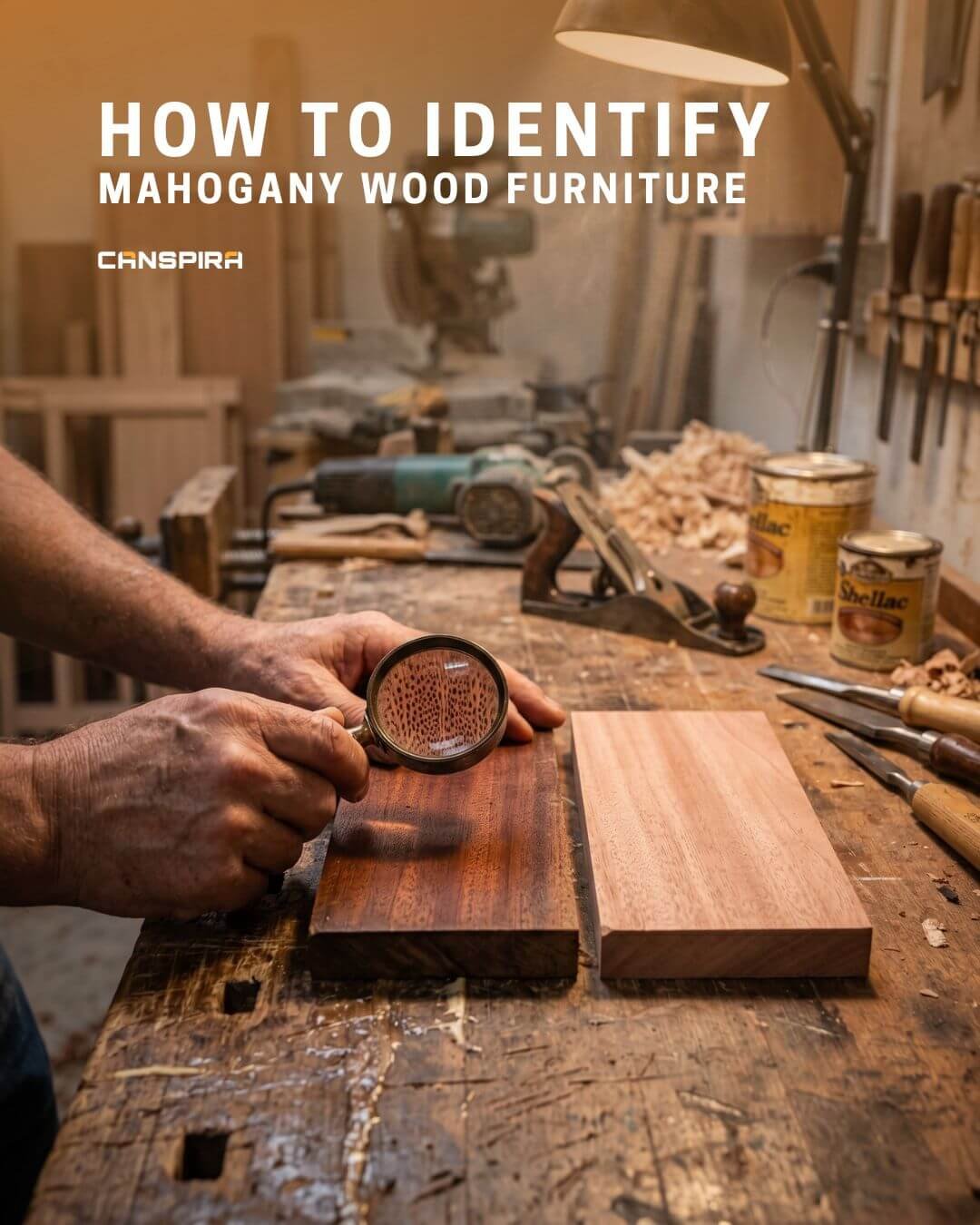
Many collectors often underestimate how expensive mahogany wood is when it is authentic and centuries-old. This wood has been the gold standard for high-end cabinetry since the 1700s, prized for its deep luster and incredible durability.
However, the market is flooded with stained pine, rubberwood, and cheap veneers that mimic its look. We have seen many buyers spend a fortune on “genuine” pieces only to realize later they bought a clever imitation.
Knowing how to identify mahogany wood furniture accurately is a skill that saves both money and regret.
Why Authenticity Matters: Genuine vs. Lookalikes
Before diving into the technical details, we must understand why people go to such lengths to fake this timber. True mahogany, specifically the Swietenia species, is a stable hardwood that resists rot and warping better than almost any other material.
- Longevity: Authentic mahogany can last for generations, often looking better at 100 years old than it did on day one.
- Investment Value: While “Philippine Mahogany” (Lauan) is common and cheap, it does not hold its value or structural integrity like the real deal.
- Workability: Master craftsmen love it because it carves beautifully without splintering, allowing for those intricate details seen in Queen Anne or Chippendale styles.
How to Identify Mahogany Wood: Physical Characteristics
When we examine a raw piece of timber or a stripped-down cabinet, certain biological markers act like a fingerprint. Relying on color alone is a mistake because stains can make almost any wood look reddish-brown. Instead, look at the cellular structure.
1. The Visible Pores
Mahogany is a diffuse-porous wood. If we look closely at a flat surface, we can see tiny indentations that look like small scratches or pinpricks.
On a finished piece of mahogany wood furniture, these pores are often filled with finish, but they should still be visible as subtle texture beneath the surface.
If the wood looks as smooth as plastic or has no visible pore structure at all, it is likely a different species.
2. Examine the Color and Aging Process
Freshly cut mahogany is often a pale pinkish-brown. However, its most famous trait is that it darkens with age. Sunlight and oxygen turn the wood into a rich, deep red or “oxblood” color.
Unlike many other woods that fade or turn gray when exposed to light, genuine mahogany gains a shimmering depth.
We often check the underside of a table; if the exposed top is dark but the protected underside is significantly lighter and pinker, that is a classic sign of authentic mahogany wood identification.
3. The Fingernail Test for Density
Since this is a genuine hardwood, it possesses a high Janka hardness rating. We often perform a simple test by finding an inconspicuous spot on the wood and pressing a fingernail into it.
A softwood like stained cedar or pine will leave a deep, permanent indentation. On real mahogany, your nail should barely leave a mark, if at all. It feels dense, heavy, and cold to the touch compared to lighter, fluffier woods.
Identifying Mahogany Furniture by Construction and Style
Furniture pieces offer more clues than raw timber because we can analyze how the wood was manipulated. High-end Indonesian mahogany furniture often showcases specific grain patterns that are nearly impossible to replicate with cheaper alternatives.
Solid Wood vs. Mahogany Veneer
Do not assume that veneer means “fake.” In the 18th and 19th centuries, the most beautiful, “flamed” sections of a mahogany log were sliced into thin veneers to create symmetrical patterns on drawer fronts.
To check for solid wood, we look at the edges. If the grain on the top of a table flows seamlessly over the edge and continues down the side, it is solid. If there is a thin line or the grain pattern “breaks” at the corner, it is a veneer.
Inspect the Joints and Stability
Because this wood is incredibly stable, it does not shrink or expand drastically with the seasons. We look at the joinery. On an old mahogany chest, the dovetail joints should still be tight.
If the wood has cracked significantly along the grain or the joints have pulled apart by more than a few millimeters, it might be a less stable wood like oak or walnut that has been stained to look like mahogany.
Common Types and Lookalikes
Navigating the world of timber names can be confusing. Many woods use “Mahogany” as a trade name even when they are not botanically related.
True Mahogany (Swietenia)
This includes Honduran and Cuban varieties. These are the “real” ones. They have the most consistent grain and the best aging properties. If a seller can verify the species as Swietenia macrophylla, we are looking at the gold standard of how to identify mahogany furniture.
African Mahogany (Khaya)
This is a very close relative and is widely used in modern high-quality furniture. It looks almost identical to Honduran mahogany but often has a more “interlocked” grain, which creates a striped appearance called “ribboning.” It is a fantastic, durable wood that we consider a legitimate choice for premium pieces.
The “False” Alternatives
Sapele is often mistaken for mahogany because of its reddish color and ribbon grain. While beautiful, Sapele is much heavier and has a distinct cedar-like scent when cut.
Then there is Philippine Mahogany (Meranti), which is much softer and more porous. It lacks the “fire” or chatoyancy that makes real mahogany shimmer when you move your head side-to-side.
Quick Checklist for On-the-Spot Identification
If we are at an antique fair or a showroom, we use this mental checklist to evaluate how to identify mahogany wood in seconds:
- Weight: Is the piece surprisingly heavy for its size?
- Pores: Can I see tiny black or brown “dashes” in the grain?
- Grain: Is the pattern mostly straight, or does it have a “ribbon” shimmer?
- Knots: Are there almost no knots? (Real mahogany logs are huge and clear).
- End Grain: On the end of a board, can we see the faint brown lines of growth rings?
Frequently Asked Questions
Is all mahogany furniture antique? Not at all. While it was the favorite of Victorian builders, it is still used today for luxury furniture, office interiors, and high-end boat fittings because of its water resistance.
Why does my mahogany look orange? This is usually due to the type of finish used, such as aged shellac or certain lacquers. If we sand a tiny hidden spot and find pinkish wood underneath, the orange is just the “skin” of the piece.
Can I identify it by smell? Unlike Cedar or Oak, mahogany does not have a very strong scent. If a piece smells very “woodsy” or spicy, it might be Sapele or a type of Rosewood instead.
Professional Insights for Your Collection
Finding the right piece requires a bit of patience and a keen eye for detail. While these tips cover the essentials of wood anatomy and furniture construction, the best way to learn is by touching and seeing as many real examples as possible.
High-quality mahogany is a tactile experience; it has a smoothness and a “heft” that cheaper woods simply cannot mimic.
Whether you are looking for a heritage antique or a modern statement piece, focusing on the grain structure and weight will always lead you in the right direction.
Many sustainable sources now provide excellent timber for contemporary designs, ensuring that this legendary wood remains a staple in beautiful homes for years to come.
Read also: Best Indonesian Solid Mahogany Wood Furniture Manufacturers dan Top Mahogany Wood Furniture Suppliers in Indonesia